Highlights:
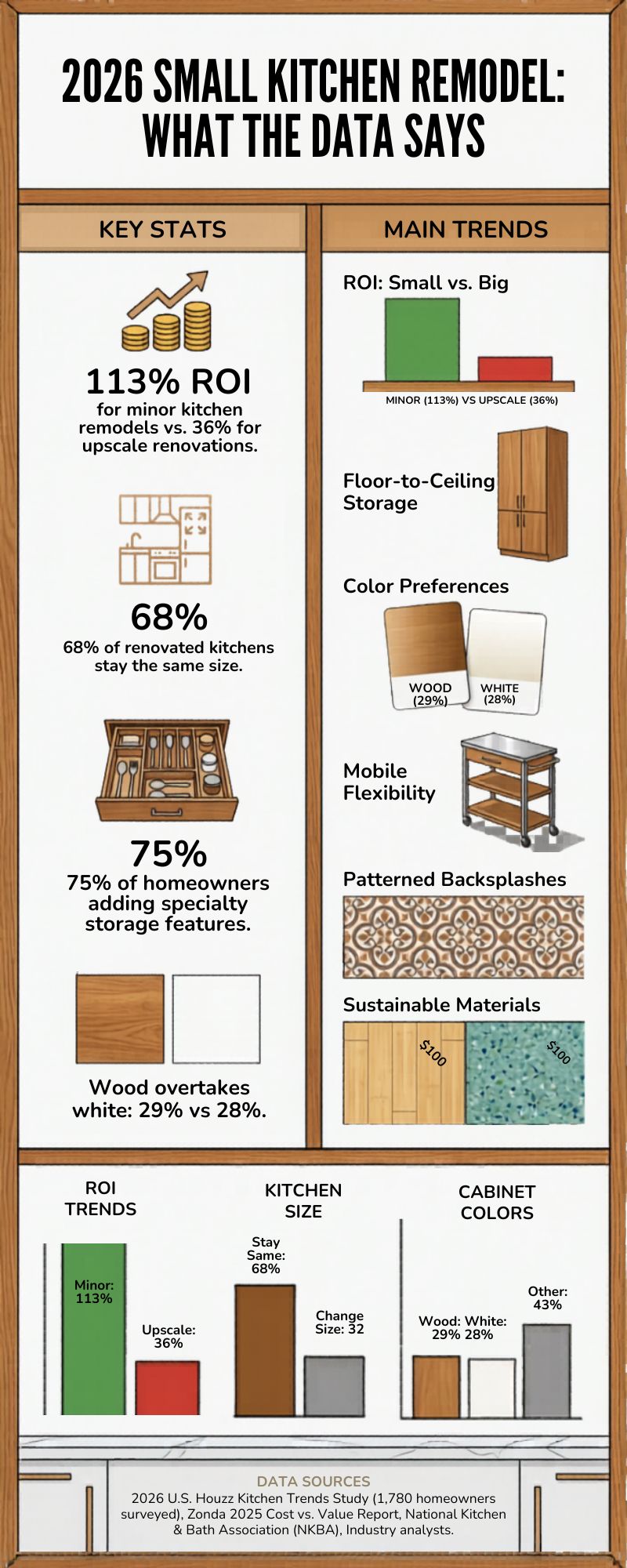
- Small beats big on ROI. Minor kitchen remodels return ~113% nationally versus just 36% for upscale gut renovations. For compact kitchens, a $15,000–$30,000 strategic refresh consistently outperforms a $75,000+ overhaul at resale.
- 68% of renovated kitchens stay the same size — and that’s the point. The dominant 2026 strategy isn’t expanding the footprint; it’s rewiring how the existing space functions through smarter layouts, zone compression, and purpose-built storage.
- Go vertical before going anywhere else. Floor-to-ceiling cabinetry is the single highest-impact investment in a small kitchen — over 75% of renovating homeowners are adding specialty storage features, and tall cabinetry can replace a walk-in pantry’s capacity without claiming an extra inch of floor space.
- Wood has officially overtaken white for the first time in years (29% vs. 28%), and the two-tone approach — warm wood lowers paired with lighter uppers — is the smartest way to bring that warmth into a compact kitchen without sacrificing brightness.
- The built-in island is the enemy of the small kitchen. Rolling carts on lockable castors are the designer-approved 2026 alternative: they serve as prep surface, dining table, and storage unit, then disappear against the wall when you need the floor back.
- The backsplash is your biggest aesthetic lever. In a galley kitchen, it’s the only uninterrupted vertical canvas available — and a quality tile investment that would go unnoticed in a large kitchen becomes the entire visual identity of a small one.
- Sustainability is now cost-competitive, not a premium. Bamboo flooring ($3–$8/sq ft), recycled glass countertops ($65–$125/sq ft), zero-VOC paint, and induction cooking aren’t green upgrades anymore — they’re durable, practical choices that happen to be better for air quality and the planet.
There is a particular kind of architectural courage required to work with a small kitchen. Anyone can make a grand space feel luxurious — throw some marble at it, widen the island, add a butler’s pantry. But a kitchen under 150 square feet? That demands strategy, restraint, and a refusal to waste a single inch. In 2026, the data confirms what smart homeowners and designers have suspected for years: small kitchens aren’t a compromise. They’re a category.
The numbers make the case. According to the 2026 U.S. Houzz Kitchen Trends Study — which surveyed 1,780 homeowners who had recently completed or were planning a kitchen renovation — 68% of kitchens end up the same size after renovation, a figure that has risen four percentage points year over year. More homeowners than ever are making the footprint they have work harder, not bigger. This isn’t budget limitation — it’s a philosophy, and it’s producing some of the most innovative kitchen design in decades.
Here are the top trends reshaping small kitchen remodels in 2026, grounded in data from Houzz, the National Kitchen & Bath Association (NKBA), Zonda Cost vs. Value, and industry analysts.
The ROI Reality: Why Small Kitchen Remodels Are the Smartest Investment You Can Make
Before getting to the aesthetic trends, let’s talk money — because the financial case for small kitchen renovation in 2026 is stronger than it’s ever been, and understanding it will change how you prioritize your remodel dollars.
The 113% Rule Nobody Talks About Honestly
According to Zonda’s 2025 Cost vs. Value Report, minor kitchen remodels return approximately 113% on investment nationally — meaning a well-executed cosmetic refresh of a small kitchen can return more value than it costs. By contrast, upscale major remodels return only about 36%. The difference is dramatic and counterintuitive to most homeowners who assume bigger equals better ROI.
What does a “minor remodel” look like in practice? It means keeping existing cabinet boxes, replacing door fronts and hardware, installing updated mid-range appliances, swapping in new counters, refreshing the sink and faucet, repainting, and replacing flooring. For a small kitchen, this scope typically runs $8,000–$15,000 nationally for a cosmetic refresh, or $15,000–$30,000 for more comprehensive updates. The full gut renovation with new cabinets and layout changes starts near $40,000 for compact spaces.
The 2026 Tariff Factor
One critical 2026 wrinkle: tariffs on imported kitchen cabinets were set at 25% in late 2025, with further increases scheduled. If you’re pricing a project now, sourcing domestic cabinet lines — or locking in pricing quickly — can meaningfully reduce your material budget. Domestically manufactured lines are shielded from these increases, and the price gap between imported budget cabinets and entry-level domestic semi-custom has narrowed considerably.
The takeaway for small-kitchen owners is liberating. You don’t need to knock out walls. You need to make intelligent choices within the space you have, and 2026’s top trends are precisely engineered to help you do that.
Trend 1: The “Work Smarter” Layout — Keeping the Footprint, Rewiring the Function
The most significant structural trend in small kitchen renovation isn’t structural at all. It’s conceptual.
With 68% of renovations maintaining the same kitchen size, the industry’s best designers have pivoted entirely toward what Houzz’s head of economic research Marine Sargsyan describes as “practical upgrades such as built-in storage and efficient layouts.” The renovation imperative has shifted from more space to better space — and for compact kitchens, this is extraordinarily good news.
Rehabilitating the Galley — and Adding a Fourth Point to the Triangle
In practical terms, this means a 2026 small kitchen remodel begins with a ruthless audit of the existing layout’s inefficiencies before touching a single cabinet. The galley layout — long maligned as a rental-unit fallback — is being rehabilitated by designers who understand that its linear efficiency is unmatched in tight spaces. The work triangle (sink, stove, refrigerator) still anchors the conversation, but 2026 design thinking adds a fourth element: the landing zone, a dedicated counter area adjacent to the refrigerator for unpacking groceries, and another near the stove for plating dishes.
Zone Compression: Task Specificity at a Smaller Scale
A key move for smaller footprints in 2026 is what designers call “zone compression” — borrowing the logic of larger task-specific kitchens and scaling it down. The NKBA’s 2026 Kitchen Trends Report found that 100% of survey respondents agreed lifestyle enhancements — including dedicated beverage areas, coffee stations, and purpose-built prep zones — will be popular layout features over the next three years. In a small kitchen, this doesn’t mean dedicating square footage to a coffee bar. It means designing a single 18-inch cabinet section with a pull-out drawer for a capsule machine, an integrated water line, and a mugs-within-reach open shelf directly above. Everything in its place, and a place for everything.
The Invisible Kitchen
The invisible kitchen — a trend that gained momentum in European micro-apartments — is also making inroads in small American spaces. Decorilla describes this approach as moving the working zone “behind pocket doors, sliding panels, or full-height cabinetry that closes flush with the surrounding wall plane.” Open, it’s a fully functional kitchen. Closed, the room becomes a seamless living space. For studio apartments and open-plan homes where the kitchen shares square footage with entertaining space, this is less a trend and more a revelation.
The practical move: Before spending money on finishes, pay a kitchen designer for a two-hour consultation on your layout. The average kitchen designer fee of $150–$300 per hour is among the highest-ROI expenditures in a small kitchen remodel.
Trend 2: Vertical Ambition — Floor-to-Ceiling Storage as a Design Statement
If small kitchens have a cardinal sin, it’s wasted vertical space. In 2026, that sin is becoming inexcusable.
What the Data Says About Storage Demand
The Houzz study found that more than three-quarters of renovating homeowners are adding specialty storage features, with pantry cabinets leading the way at 47%. For small kitchens, pantry-style floor-to-ceiling cabinetry is the single highest-impact investment available — it adds substantial storage without expanding the footprint by a single inch. The NKBA’s research further confirms this direction: floor-to-ceiling cabinetry with more drawers is topping designer wish lists for clients across all budget levels. In compact spaces, a well-designed run of tall cabinetry can replace a walk-in pantry’s entire storage capacity.
The Handleless Cabinet Aesthetic
The design language around this trend has matured considerably. Gone are the bulky, imposing overhead cabinets that made small kitchens feel like equipment rooms. In their place: flat-front cabinets with integrated handles or push-to-open mechanisms. George Cabinetry notes that handleless cabinet designs are “particularly effective in smaller kitchens, as they enhance a sense of space while maintaining a clean, streamlined aesthetic.” When the hardware disappears, the eye reads the cabinet run as a continuous architectural surface rather than a collection of individual boxes. The room feels larger without being larger.
Mixed Materials and Glass Inserts
Mixed-material cabinetry — combining wood with glass inserts, or introducing a single run of open shelving within a predominantly closed cabinet scheme — breaks visual monotony while maintaining storage discipline. Glass-front upper cabinets in a compact kitchen serve double duty: they store items and make the wall feel more open, introducing depth without removing square footage.
The Economics of Pull-Outs and Corner Solutions
Pull-out mechanisms, once considered luxury additions, are rapidly becoming standard in small kitchen remodels. Industry cost data puts pull-out shelves at $150–$300 per unit, and a comprehensive storage upgrade at $2,000–$4,000 — a fraction of what expanding your kitchen’s footprint would cost. Corner solutions — rotating carousels, magic corner systems, and diagonal drawer configurations — are finally reaching a price point that makes them accessible in mid-range remodels.
The practical move: Measure the dead space between your highest cabinet and the ceiling. If it’s more than 12 inches, you’re leaving storage on the table. A run of shallow upper cabinets in that zone, dedicated to rarely-used items, can free up an entire cabinet of prime real-estate storage below.
Trend 3: Wood Overtakes White — The Material Shift That Changes Everything for Small Spaces
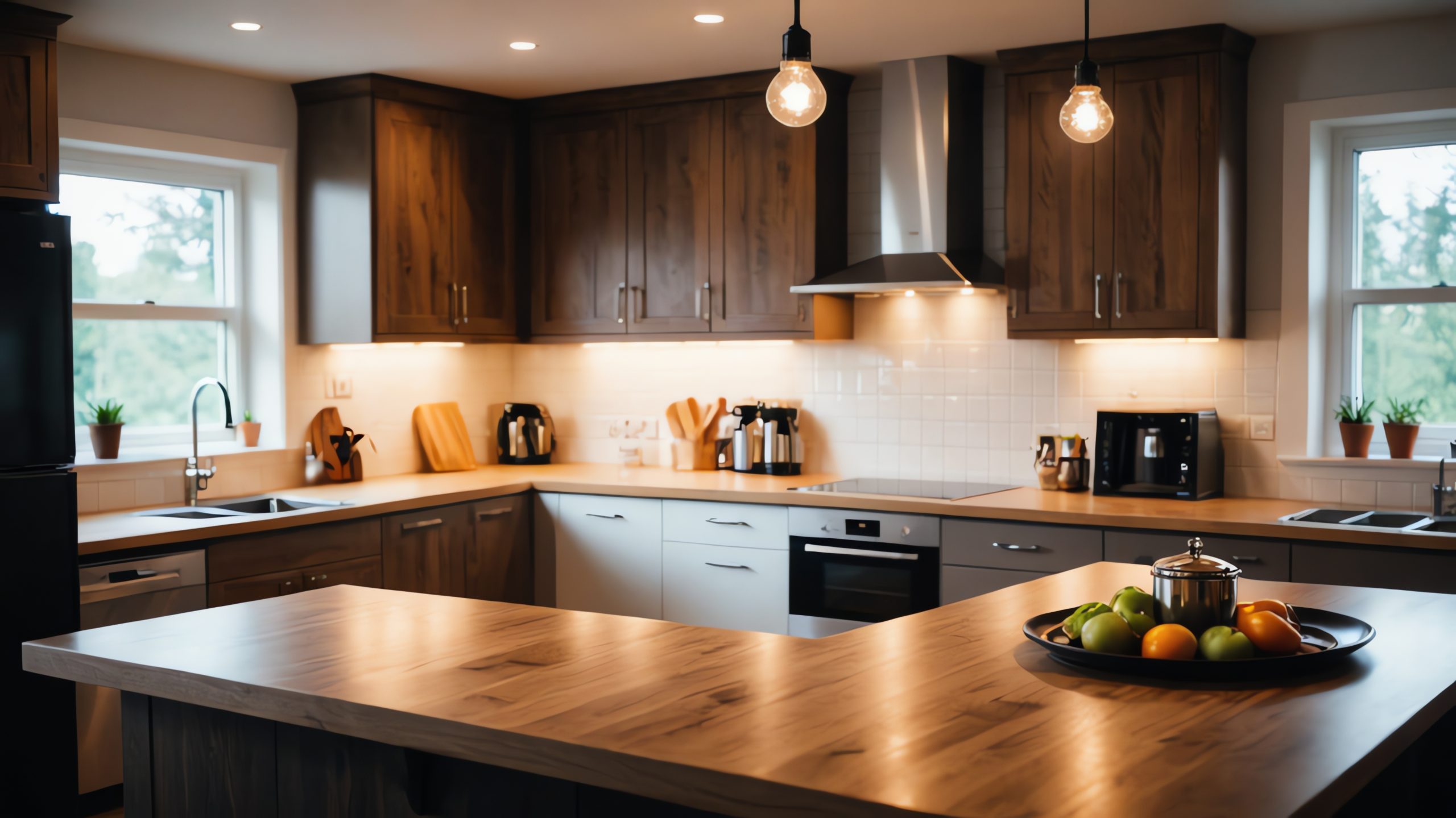
For the first time in years, wood cabinets have claimed the top spot in the Houzz study. Nearly 3 in 10 renovating homeowners (29%) are choosing wood cabinets — a six-percentage-point jump — pushing white into second place at 28% after a significant decline. This is not a minor aesthetic footnote. It’s a fundamental shift in how Americans think about kitchen warmth and character, and it has specific, important implications for small spaces.
Rethinking the “Light = Large” Myth
The conventional wisdom about small kitchens has long insisted on white or very light finishes to maximize perceived brightness. That advice isn’t wrong, but it’s incomplete. Medium-toned woods — the leading sub-category at 15% of renovating homeowners — bring warmth and visual texture that white simply cannot. In a small kitchen, this texture is crucial: it gives the eye something to rest on, making the space feel considered and intentional rather than minimal by necessity.
The key to making medium and warm wood tones work in compact kitchens is contrast and light. Homes & Gardens reports that interior designer Rebecca Hughes sees clients increasingly using “high-quality materials” to “immediately elevate the space, while reflective elements like a mirrored backsplash are becoming more popular, helping bounce light around the room.” Pair a warm walnut or oak cabinet face with a light, reflective countertop and a mirrored or metallic backsplash, and you get the warmth of wood without sacrificing brightness.
The Two-Tone Solution
The two-tone kitchen — combining warm wood lower cabinets with lighter or white uppers — is the elegant solution to this tension, and it’s gaining significant traction in small spaces. Reico Kitchen & Bath notes that homeowners are increasingly pairing dark lower cabinetry with lighter upper cabinets, creating depth and contrast without overwhelming a compact room. The lower cabinets visually ground the space while the lighter uppers keep the room airy.
Countertop Contrast and the Color Fringe
For countertops, white and off-white remain dominant, but 2026 is seeing a rise in contrast countertops — particularly on kitchen islands and peninsulas, where a different surface material anchors the feature piece within the broader kitchen design. If your small kitchen has a peninsula rather than an island, consider this move: a contrasting countertop turns the peninsula from a practical afterthought into the room’s focal point.
Off-white cabinetry holds steady at 15% — a reliable choice for small kitchens where the desire is for warmth without full commitment to wood grain. Green has now edged past gray (6% vs. 5%), signaling that subtle color is no longer niche. In a small kitchen, a single sage green or forest green cabinet run — paired with warm wood shelving — can create an impression of sophisticated personality without committing to a full color renovation.
The practical move: If you’re replacing cabinet fronts (not boxes), medium-toned thermofoil or veneer in oak or walnut finishes can achieve the wood-tone look at a fraction of solid wood cost, while maintaining the durability required in a high-use small kitchen.
Trend 4: The Portable Island and the Anti-Island — Small Kitchen Flexibility Takes Center Stage
The traditional built-in kitchen island is, for most kitchens under 150 square feet, an obstacle with a countertop. In 2026, designers are finally saying this out loud — and offering something better.
Why the Built-In Island Fails Small Kitchens
The Homes & Gardens small kitchen trend report is explicit: a traditional built-in island “often doesn’t fit into a more compact scheme” and falls into “the outdated design rules you can ignore in small kitchens.” In its place, portable work tables and kitchen carts — on lockable castors, with integrated storage below — are the designer-approved alternative expected to dominate in 2026.
The genius of the rolling cart in a small kitchen is its transformative flexibility. When you’re cooking, roll it into the work zone. When you’re eating, it becomes the dining surface. When guests arrive, push it against the wall and you’ve reclaimed the floor plan. This isn’t improvisation; it’s deliberate multifunctionality — a design principle that the NKBA report identifies as central to kitchen evolution over the next three years.
Engineering the Peninsula for Maximum Return
For kitchens that do have room for a modest peninsula or fixed partial-island, the 2026 approach is to engineer every inch of that structure for multiple uses. A 36-inch peninsula can incorporate: seating for two on the living-room side, three pull-out drawers on the kitchen side, a built-in wine rack at the end, and a pendant light above that serves as the room’s design anchor. The NKBA study found that 94% of respondents agree homeowners are adding functional flex spaces — and in small kitchens, every fixed element must justify its footprint by serving multiple roles simultaneously.
The practical move: If you’re drawn to a rolling cart, invest in one with a butcher-block or stone top (not cheap laminate), lockable wheels, and closed lower storage. It should look intentional, not improvised. Budget $300–$900 for a unit that will read as a design decision rather than a placeholder.
Trend 5: Smart Technology — The New Space Multiplier
In 2026, smart kitchen technology has evolved past the novelty phase and into genuine utility — and for small kitchens, where every square inch must earn its keep, this distinction matters enormously.
The Multifunctional Appliance Revolution
The NKBA’s 2026 report identifies smart technology as gaining significant traction across all kitchen categories, including WiFi-enabled appliances, mobile-app controlled lighting, and embedded wireless charging. But the more interesting story for small kitchens isn’t the connected refrigerator — it’s the multifunctional appliance revolution.
Counter-depth and compact smart appliances are allowing small kitchens to reclaim significant counter real estate. Energy-efficient smart appliances command a 20–40% premium over standard units, adding $2,000–$5,000 to a project budget. But consider the trade-off: a combination convection oven/microwave/air fryer unit in 24 inches of width replaces three separate appliances and frees two appliance garages worth of counter space. ENERGY STAR data shows that modern smart refrigerators use 40% less electricity than standard models — and in small kitchens where counter-depth fridges are often necessary, choosing the energy-efficient option reduces both the appliance’s footprint and its operating cost over a decade.
Lighting as a Functional Necessity, Not a Finish
Under-cabinet LED lighting systems — a relatively modest investment at $40–$200 for a small kitchen run — transform how a compact space reads. The NKBA report found that 95% of homeowners cite natural lighting as a top design consideration, with quality lighting (93%) and task lighting (92%) close behind. In a small kitchen with limited window access, under-cabinet strips that provide focused, adjustable task lighting can effectively double the usability of the workspace during evening hours. These are not luxury add-ons; they’re functional necessities that also happen to be visually transformative.
The Induction Argument for Compact Kitchens
Induction cooking technology deserves special mention for small kitchen remodels. Induction cooktops run at 85–90% energy efficiency versus 40% for gas, and — critically for compact spaces — they produce no ambient heat, which reduces the burden on ventilation and makes cooking in a tight kitchen dramatically more comfortable. The NKBA reports that 85% of designers cite powerful vent hoods as a growing client demand, a figure that speaks directly to the small kitchen challenge of managing heat, steam, and odor in constrained square footage.
The practical move: Before budgeting for smart appliances, identify the one or two kitchen tasks that create the most friction in your current space. Buy smart technology that solves those specific problems first. WiFi-connected appliances you don’t need are just expensive gadgets that crowd your counters.
Trend 6: Backsplashes as the Small Kitchen’s Canvas
In a compact kitchen where cabinetry is streamlined and counters are limited, the backsplash becomes the room’s primary artistic statement — and 2026 designers are treating it accordingly.
Why the Backsplash Carries Disproportionate Weight
Interior designer Rebecca Hughes puts it directly: “More than ever, we’re seeing our clients view their compact kitchen as an opportunity to be brave and considered, rather than compromised. Using high-quality materials immediately elevates the space.” The backsplash — spanning the zone between counter and upper cabinet — is where brave choices pay the highest visual dividends in a small kitchen, because it’s essentially the only uninterrupted vertical surface available for expression. The smaller the kitchen, the higher the visual return: a $1,200 tile installation in a full-size kitchen is barely noticed, but in a galley kitchen with 20 linear feet of backsplash exposure, it’s the room.
Mirrored, Metallic, and Material Drama
Mirrored and metallic backsplashes are gaining rapid traction in compact kitchens for functional as well as aesthetic reasons: they bounce light, create the illusion of depth, and give the kitchen a polished, intentional quality that elevates even modest cabinetry around them. Decorative tile — including the revival of hand-painted and artisanal tile patterns — allows homeowners to inject personality into a kitchen whose scale limits other expressive moves.
Going Dark: The Case for Warm, Deep Hues
Warm, dark tones — burgundy, plum, rich terracotta — are also trending in small kitchen color stories for 2026. These hues, when used on a backsplash or in cabinetry, create the cozy, intimate atmosphere that works with a small space rather than against it. A small kitchen doesn’t have to feel large; it can feel like a perfectly calibrated room that knows exactly what it is.
The practical move: Subway tile in a running bond pattern (the classic horizontal arrangement) actually shortens the visual length of a galley kitchen. Consider a vertical or herringbone pattern instead — it draws the eye upward and outward, making the wall feel taller and the space feel wider.
Trend 7: Sustainability as Strategy, Not Sentiment
Eco-conscious materials have been a kitchen trend for years, but in 2026 they’ve crossed a threshold: they’re now genuinely cost-competitive and functionally superior in several key categories — which matters especially in small kitchens where durability and low maintenance are non-negotiable.
Materials That Have Earned Their Place
Reico Kitchen & Bath notes that homeowners are increasingly pairing bamboo or reclaimed wood cabinet doors with quartz countertops, describing it as “a timeless design while keeping your kitchen remodel budget smart.” Bamboo as a flooring material runs $3–$8 per square foot — at the lower end of the flooring budget — while offering durability that outperforms many traditional hardwoods in kitchen environments. Recycled glass countertops have reached $65–$125 per square foot, making them genuinely competitive with granite while delivering something neither quartz nor stone can: visible, meaningful sustainability credentials and a surface that is genuinely unique to each installation.
Air Quality and Wellness in Compact Spaces
The NKBA’s 2026 report specifically identifies wellness-focused spaces and organic, earthy materials as core trends, noting that steam cooking (66% of designers cite it as growing), powerful ventilation (85%), and health-conscious design features are gaining traction. In small kitchens where air quality is particularly sensitive to cooking emissions, a quality ventilation hood combined with induction cooking technology is the sustainability investment with the most immediate daily impact.
The Low-VOC Imperative
Low-VOC paints — now standard practice among quality kitchen painters — matter more in compact spaces where occupants spend significant time close to the painted surfaces. If you’re refreshing your small kitchen with paint (one of the highest-ROI changes you can make at $200–$600 for materials and labor), choose a zero-VOC interior paint as a baseline requirement, not an upgrade.
The practical move: The single most impactful eco-upgrade for a small kitchen in 2026 costs almost nothing to decide at the design stage: keep your existing cabinet boxes and replace only the fronts. This eliminates the environmental cost of manufacturing new cabinet boxes, reduces construction waste, and — at 60–70% of the cost of full cabinet replacement — frees budget for upgrades elsewhere.
Conclusion: The 2026 Small Kitchen Mindset
The data from Houzz, NKBA, Zonda, and every competent designer working in the space converges on a single insight: small kitchens in 2026 are winning not despite their constraints but because of them. The limitations of square footage are forcing a precision of thought — about storage, about workflow, about material investment, about what each element truly needs to accomplish — that larger kitchens rarely demand and often never achieve.
The homeowners doing this best are the ones who have stopped apologizing for their kitchen’s size and started treating its boundaries as a design brief. They’re investing in vertical storage rather than square footage. They’re choosing material quality over material quantity. They’re making one or two brave choices — a warm wood tone, a dramatic backsplash, a perfectly proportioned pendant — and letting those choices carry the room.
The financial logic backs the aesthetic logic perfectly. A well-executed small kitchen remodel in the $20,000–$40,000 range, done with strategic clarity, returns more value at resale than a sprawling gut renovation that costs three times as much. Minor remodels return 113% nationally. Upscale renovations return 36%. The math is unambiguous.
In 2026, the small kitchen is not a problem to be solved. It’s a challenge to be embraced — and the best thing you can do for yours is to start treating it that way.